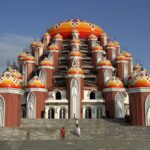
Medan is the capital of North Sumatra Province and the centre of its government and economic activity. It has a strong legacy from the Deli Sultanate, a handful of old mosques, and a food scene of remarkable variety. That variety is exactly why Muslim travellers should be a little more careful here: Medan is also known as a centre of non-halal cuisine, so not every eatery is automatically safe for you. This guide covers the mosques worth visiting, the dishes Medan is known for, and how to confirm halal status while you are there.
One note up front: "halal travel" in this article means destinations that are friendly to Muslim families, meaning easy to pray and easy to choose food. It is not a claim that the places mentioned are halal-certified. We did not find halal certification details for any eatery on this list.
Historic Mosques in Medan
Al-Mashun Grand Mosque
This is Medan's religious landmark. Construction began on 21 August 1906 and finished on 10 September 1909, ordered by Sultan Ma'mun Al Rashid Perkasa Alam of the Deli Sultanate. Its capacity is given as roughly 2,000 worshippers. The mosque is on Jalan Sisingamangaraja, only about 300 metres from Maimun Palace, so the two are easy to combine on a short walk or becak ride. A 2023 detik report said there is no entry fee, but rules like this can change, so ask the management when you arrive. Visit outside prayer times if you want to see the building at a relaxed pace, and dress modestly.
Al-Osmani Mosque (the Yellow Mosque), Labuhan
Located in the Labuhan area, this mosque was built in 1854 and is described as the oldest in Medan. Its yellow colour makes it easy to recognise. It is some distance from the city centre, so set aside separate travel time if you want to go.
Gang Bengkok Mosque, Kesawan
This mosque is on Jalan Mesjid in the Kesawan district and is said to date from about 1873 or 1874, depending on the source. One write-up says it was designated a cultural heritage site in 2021. Its distinctive feature is a Chinese-temple-style roof combined with a Malay umbrella element, in green and yellow. Several sources link its funding to Tjong A Fie, a Chinese merchant, but that account rests on interviews rather than archives, so treat it as a story in circulation.
Medan Grand Mosque
On Jalan Diponegoro, this mosque holds around 10,000 worshippers and has a tower you can climb for a view over the city. It is a practical place to pray when you are downtown.
Route Companions: Maimun Palace and the Tjong A Fie Mansion
Maimun Palace on Jalan Brigjen Katamso is the natural partner to a visit to Al-Mashun because it is so close. The opening hours and ticket prices we found date from 2023 and have probably changed, so check before you go. For history lovers, the Tjong A Fie Mansion, built in 1895 and open to the public since 2009, offers another side of Medan's past.
Local Food
Dishes often described as typical of Medan include lontong Medan, soto Medan, bubur pedas, mie balap, mie gomak, lemang, and bika ambon. Bika ambon takes its name from Jalan Ambon, where its sellers were once known, not from the city of Ambon. Two places that often appear in food write-ups are Soto Sinar Pagi on Jalan Sei Deli and Rumah Makan Tabona, known for curries. We did not find halal certification details for either, so do not assume halal status from reputation alone.
Important: Medan and Non-Halal Food
This is the part that deserves your closest attention. According to a review we read, Medan is a centre of non-halal cuisine, including Chinese and Batak dishes that use pork. Many long-running eateries also do not display a halal label. That means the absence of a label tells you nothing either way: it does not mean the food is halal, and it does not mean it is not. A few simple steps help:
- Choose eateries that clearly display a halal label or certificate, or that are run by and known as Muslim restaurants.
- Ask directly about ingredients and cooking methods, especially for broths, sambals, and Batak dishes, which can come in more than one version.
- Check whether the kitchen and utensils are shared with non-halal food.
- For packaged souvenirs, use BPJPH's halal product check service.
Practical Tips
First, plan your prayer stops. The mosques in the centre (Al-Mashun, Gang Bengkok, the Grand Mosque) sit in a relatively compact area, but Al-Osmani in Labuhan needs its own travel time. Second, on regulation: BPJPH says mandatory halal certification for food and beverage products from micro and small businesses applies from 18 October 2026, with no postponement (statement by BPJPH's head, June 2026). We did not find reports on how it is being applied on the ground since that date, so some small stalls may still be processing their certificates. Third, carry water and snacks as a backup in case it is hard to find food you are sure about.
FAQ (Frequently Asked Questions)
Is all food in Medan halal?
Not automatically. Medan has many non-halal eateries and many long-established stalls without labels. Confirm through halal labels, direct questions to the seller, and BPJPH's check.
What is the most famous mosque in Medan?
Al-Mashun Grand Mosque, completed in 1909 and ordered by Sultan Ma'mun Al Rashid Perkasa Alam.
Which mosque is described as the oldest in Medan?
Al-Osmani Mosque in Labuhan, built in 1854.
Can I visit Al-Mashun Mosque and Maimun Palace on the same day?
Yes. They are about 300 metres apart, so they combine easily into one morning or afternoon route.